Operational Efficiency for Small Business: 3-Lever Playbook
The Owner-Operator Trap traps most SMEs. Learn the three-lever framework to fix processes before tools, then automate and delegate. 30/60/90 roadmap included.
The Verdict: Operational efficiency for small businesses is the measure of how much your business produces relative to the time, money, and effort it consumes — and, specifically, how many of those inputs depend on you personally. Most SMEs are inefficient not because of poor effort, but because of structural dependency on the owner.
Critical Insights:
- Employees lose up to 20% of their working week searching for information across disconnected platforms — time your business pays for without capturing any output (HBR).
- The single most common efficiency mistake in small businesses is automating a broken process — which produces a faster broken process, not a fixed one.
- Small businesses that tighten their systems see a 30% jump in productivity within one year (McKinsey, via Small Business Trends); lean management techniques have cut operational costs by up to 20% in SMEs.
- 1 in 4 small businesses currently uses AI; those that do are 12 percentage points more likely to grow profits — but AI without a redesigned process underneath it adds complexity, not leverage (SBA, 2024).
- The three levers unlocking operational efficiency — process redesign, automation, and decision delegation — must be applied in that sequence. Reversing the order is the most expensive mistake owners make.
You’re running the business, but the business is running you. If improving operational efficiency for your small business feels urgent but shapeless — every system creaking at once, no clear starting point — that’s exactly the condition this framework is built for.
What “Operational Efficiency” Actually Means for an SME
“Operational efficiency for a small business is the ratio of useful output to total input — measured not in spreadsheets, but in a simpler question: how much of what the business produces depends on you, personally, being in the room? The more it does, the less efficient the operation.”
That framing matters because the enterprise definition — maximise the output-to-cost ratio across departments — assumes you have departments, dedicated process owners, and a Chief Operating Officer to run them. Most businesses in the 5–50 employee range have none of those things. Applying an enterprise lens to an SME operations problem produces advice that is either irrelevant or actively misleading.
Operational efficiency, for a business at your scale, isn’t about squeezing more hours from the day. It’s about building a business that runs reliably with the team already in place — one that doesn’t grind to a halt when you’re unavailable for a day, a week, or longer. Fewer decisions only you can make. Fewer manual handoffs between tools that don’t connect. Fewer tasks depending on a single person’s presence or memory.
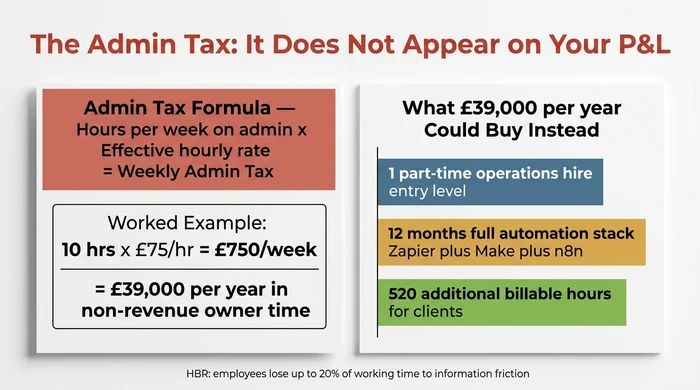
The Admin Tax is the most tangible symptom. It’s the time — and therefore the money — consumed by administrative work generating no revenue: data entry, status chasing, report assembly, information hunting. It doesn’t appear on the P&L, but it appears very clearly in your diary and in the creeping sense the business is consuming more than it produces.
The good news: SME inefficiency is rarely random. It’s almost always caused by the same structural problems — and addressed by the same three levers.
The Owner-Operator Trap — Why SME Inefficiency Is Structural, Not Personal
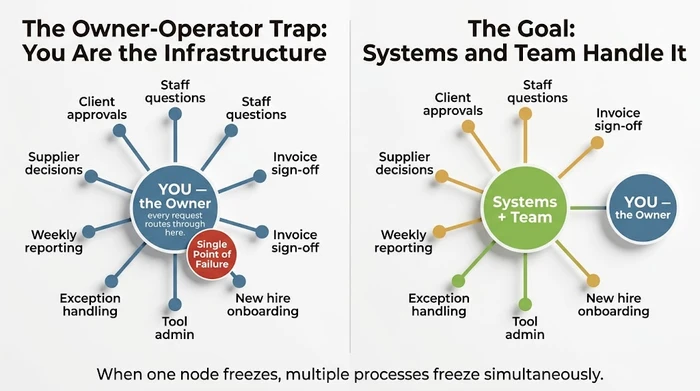
Every growing business eventually creates this problem — and it’s not your fault. The Owner-Operator Trap is the structural condition in which the business owner has become the primary bottleneck: the approval node, the knowledge silo, and the decision point everything routes through.
When a business starts, the owner is the system. They hold all the knowledge, make all the decisions, and perform most of the work. For a one-person operation, this is actually efficient — there’s no overhead from communication or coordination. The problem emerges when the team grows but the knowledge and decision authority never get transferred. The owner gets busier; the team gets larger; the routing structure stays the same.
The result is what the owner becomes: the human router. Every request, approval, and exception passes through them before it can proceed. The team may be entirely capable. They simply don’t have the authority or the information to act without checking first. So they check — constantly, about everything.
The Jenga tower analogy captures the risk precisely. Each person holding exclusive knowledge of a process is a critical block in the tower. When one block is removed — the owner on holiday, ill, or simply overwhelmed by one crisis — other parts of the structure become unstable. Projects stall. Clients wait. The team freezes.
Three symptoms confirm the Owner-Operator Trap is in play:
- Decisions stall or slow when you’re unavailable for more than half a day.
- New staff require extended shadowing before they can work independently — because the process lives in someone’s head, not a document.
- You’re still doing tasks you built the team to handle, because handing them off would require explaining a process no one has ever written down.
The Owner-Operator Trap isn’t solved by working harder or hiring more people. It’s solved by redesigning how the business makes decisions and executes recurring tasks — which is exactly what the three-lever framework does.
The Three Levers of Operational Efficiency
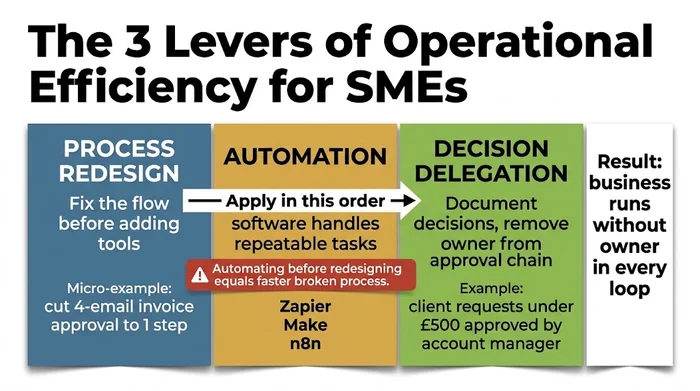
The three levers — process redesign, automation, and decision delegation — must be applied in sequence. This is the most important structural insight in the framework: the order is not a preference, it is a dependency. Automating before redesigning produces a faster broken process. Delegating before automating moves the bottleneck from owner to team member without removing it.
Lever 1: Process redesign — always first. Remove unnecessary steps, clarify ownership of each remaining step, and eliminate manual handoffs before any tool is introduced. The Tech-Before-Process Trap — jumping to tool selection before understanding why the process is broken — is responsible for more failed workflow implementations than any other cause.
Lever 2: Automation — second, not first. Automation is rule-based software executing a repeatable task without human involvement. It’s not AI. Zapier (£19/month), Make (£9/month), n8n (self-hosted, near-zero cost), and Power Automate handle most SME needs — but only after the underlying process has been redesigned.
Lever 3: Decision delegation — third. Documenting the criteria for a recurring decision so a team member or policy can make it, without adding headcount. A single written rule removes one daily interruption and scales indefinitely.
Where to Start — Diagnosing Your Worst Bottleneck
Most efficiency guides present strategies without triage. The real question isn’t which strategy to use — it’s which problem to fix first. Getting this wrong means spending a month improving a process that wasn’t limiting your throughput.
SME bottlenecks fall into four types: owner as approval node, knowledge silos (processes that live only in one person’s head), data silos (tools that don’t connect, creating human middleware), and process debt (steps with unclear ownership or unnecessary complexity). Each type calls for a different first lever.
The self-diagnosis checklist below scores your business across all four dimensions. Use the interactive version to get your score and a direct next step.
Scoring key (static reference):
- 1–3 yes: Isolated issues — start with the highest-impact one.
- 4–6 yes: Systemic inefficiency — the Owner-Operator Trap is likely in play.
- 7–10 yes: The business is running on you as infrastructure — start with the full bottleneck diagnostic.
The Admin Tax — Calculating What Inefficiency Is Costing You
The number is usually a shock. The Admin Tax is the weekly cost of time spent on non-revenue-generating administrative work: manual data entry, status chasing, information hunting, report assembly. It doesn’t appear on the P&L. It appears in owner exhaustion, missed deadlines, and the creeping sense the business is consuming more than it produces.
The calculation is straightforward:
When spread across a team of five people, each losing 20% of their working week to information friction — as HBR research found is common across businesses with disconnected platforms — the figure is closer to one full-time equivalent lost per week to administrative overhead. That’s not a rounding error; that’s a salary.
Building Systems That Run Without You
A business that can’t operate without you doesn’t have systems — it has habits. Converting habits into systems means documenting the 10–15 recurring processes that run the business, transferring decision authority through written delegation policies, and applying a consistent scoring method to every recurring task so the hire-vs.-systematise-vs.-automate question gets a reliable answer instead of a gut-feel one.
Process documentation doesn’t require an ISO manual — a bullet list someone else can follow without asking you is the minimum viable standard. Decision delegation produces more consistent outcomes than ad hoc owner judgement because the rule applies the same way every time, whether or not you’re in the building. The hire-vs.-automate scoring matrix (frequency, time cost, error rate, owner-dependency, documentation status) removes the guesswork from a decision most owners currently get wrong in one of two directions: over-automating tasks that don’t need it, or continuing manual ownership of tasks that should have been systematised months ago.
Measurement, Data Silos, and the Owner’s Dashboard
You do not need an ERP to measure operational efficiency. Five numbers in a spreadsheet, reviewed every Monday morning, provide a meaningful baseline for any 5–50 person business: revenue vs. plan, outstanding receivables over 30 days, hours billed vs. capacity, open tasks past due date, and one metric tied directly to your current worst bottleneck.
Data silos — tools that don’t connect, creating human middleware — are the most immediately fixable source of operational friction in most SMEs. An integration tool (Zapier, Make, or n8n) eliminates manual data transfer without requiring a developer. The fifth dashboard metric is how you confirm that your bottleneck fix held, rather than assuming it did.
Tool adoption, not tool selection, is the primary risk in any measurement or integration project. In small businesses, adoption is determined almost entirely by whether the owner uses the new system visibly and consistently.
Variations and Exceptions — When the Standard Advice Does Not Apply
- During a customer crisis: if a client relationship is actively at risk, fix that first. Efficiency work done during a crisis tends to solve the wrong problem.
- When the bottleneck is sales, not operations: if the business has capacity to grow but no pipeline to fill it, systematising the back office will not move revenue. Fix the demand problem first.
- When your team is below 50% capacity: optimising a system not under load is premature. Add work before you add efficiency systems.
- When you are about to make a major structural change (hiring a first manager, changing your service model, entering a new market): wait until the structure is settled before systematising the current state.
- When the last system change did not stick: diagnose why adoption failed before adding another. The problem is usually insufficient explanation of the “why,” not the tool itself.
Beyond those hard stops, a few conditional scenarios are worth naming explicitly.
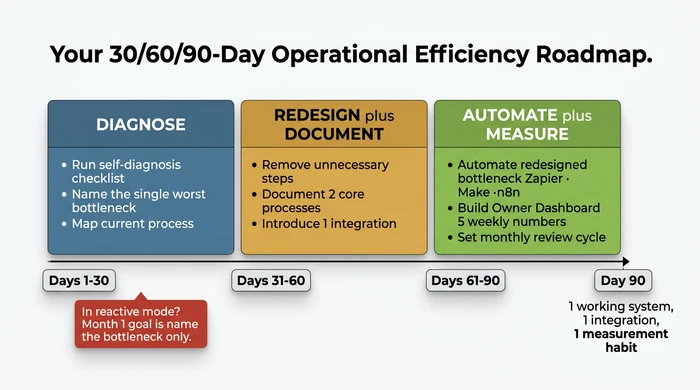
If you’re in survival mode rather than growth mode, the 30/60/90-day roadmap below still applies — but Month 1 is purely triage. Don’t attempt to redesign, automate, or document while in reactive mode. Name the bottleneck. That’s the only goal for the first thirty days.
If you’ve already tried automation and it made things worse, the three-lever sequence explains why. Automation before process redesign reliably increases complexity. Return to Lever 1: map what actually happens, remove unnecessary steps, then reassess whether automation is still needed.
If your team is at five staff vs. forty-five staff, the hire-vs.-systematise question has meaningfully different answers at those scales. The decision matrix in the systems guide accounts for this partially; the full treatment is in that spoke.
“Efficiency work earns its place when the operation is genuinely under load and the constraint is internal, not external. If the constraint is demand, no amount of process improvement will generate revenue.”
Your 30/60/90-Day Operational Efficiency Roadmap
Every system feels broken at once. Here’s the starting sequence anyway.
Sequential improvement compounds faster than parallel improvement. Fix the worst bottleneck first, demonstrate the gain, then move to the next. Attempting to fix everything simultaneously is how transformation projects fail in small businesses.
Month 1 — Diagnose (Days 1–30)
Run the self-diagnosis checklist above. Identify the single worst bottleneck — the one process or dependency most often freezing the business or consuming the most owner time. Map the current process, even roughly. A whiteboard diagram or a bullet list of steps is sufficient.
If you’re firefighting, the only goal this month is identifying the bottleneck. Don’t attempt to redesign, automate, or document while in reactive mode. Diagnosis under pressure is still diagnosis.
Month 2 — Redesign and document (Days 31–60)
Redesign the bottleneck process: remove unnecessary steps, clarify ownership of each remaining step, and eliminate any manual handoffs where a direct connection is possible. Document two core recurring processes in writing — not in your head, not in email threads.
Introduce one integration if a manual data-transfer step exists between two tools. Test the redesigned process manually for a full week before adding any automation layer on top.
Month 3 — Automate and measure (Days 61–90)
Automate the redesigned bottleneck process (Zapier, Make, or n8n depending on complexity and cost preference). Build the Owner’s Dashboard — five numbers, reviewed every Monday. Establish a monthly review cycle: one hour to identify the next bottleneck and assess whether last month’s improvement held.
By Day 90, the business has one working system, one integration, and a measurement habit. That’s more operational infrastructure than most five-to-thirty-person businesses have in place. The compound effect of repeating this cycle every quarter is significant.
Glossary
Operational efficiency — The ratio of useful output to total input. For an SME, the practical measure is how much of that output depends on the owner being personally involved. The goal is to maximise output while reducing owner-dependency.
Owner-Operator Trap — The structural condition in which the business owner has become the primary bottleneck: the approval node, knowledge silo, and decision point everything routes through. It forms naturally as a business grows without transferring knowledge or authority to the team.
Admin Tax — The hidden time cost of non-revenue-generating administrative work: data entry, status chasing, report assembly, information hunting. It doesn’t appear on the P&L but compounds directly into owner exhaustion and missed capacity.
Process redesign — Reviewing and restructuring how a recurring task flows before applying any technology. Always the first lever of the three-lever framework.
Automation — Rule-based software executing a defined, repeatable task without human involvement each time it runs. Distinct from AI: automation runs identically every time; AI applies judgement and produces variable outputs.
Decision delegation — Documenting the criteria for a recurring decision so a team member or a policy can make it, removing the owner from the approval chain. Not the same as hiring.
Bottleneck — The single step or person limiting the throughput of a system. Often the owner; sometimes a tool, an approval loop, or a missing integration.
Integration — An automatic connection between two software tools allowing them to exchange data without a human copying it. Eliminates the human middleware problem. Think of it as your tools talking to each other without you in the middle.
Human middleware — Staff (or the owner) spending time manually moving information between non-integrated tools. A symptom of data silos, not a job description.
System — A documented, repeatable sequence of steps producing a consistent outcome regardless of who performs it. The goal of operational efficiency work is to convert informal habits into systems.
Frequently Asked Questions
Q: What causes most inefficiency in small businesses?
The Owner-Operator Trap. The structural pattern in which the owner is the approval node, the knowledge silo, and the bottleneck everything routes through accounts for the majority of SME inefficiency. Compounding factors include undocumented processes, non-integrated tools generating manual data transfer, and the absence of any measurement system to surface where time is actually going.
Q: What is the best first step to becoming more operationally efficient?
Identify the single worst bottleneck — the one process or dependency causing the most damage when it slows or stops. Use the self-diagnosis checklist above. Don’t start by selecting tools or building dashboards until the bottleneck is named. Starting with tool selection before diagnosis is the most common way efficiency projects stall before they begin.
Q: How do you measure operational efficiency without enterprise tools?
Start with five weekly numbers tracked in a spreadsheet: revenue vs. plan, outstanding receivables over 30 days, open tasks past their due date, hours billed vs. capacity, and one metric tied directly to your current worst bottleneck. An ERP is not required to establish a meaningful operational baseline.
Q: How can small businesses improve efficiency without a large budget?
Process redesign costs nothing — it requires only time and a willingness to question how things are done. Free or near-free tools (n8n self-hosted, Notion free tier, Google Sheets) handle the majority of SME automation and documentation needs at the starting point. Before spending on any software, calculate the human time cost of the manual process you’re trying to fix. In most cases, the Admin Tax far exceeds the cost of the tool eliminating it.
Q: How does automation help with operational efficiency?
Automation removes human involvement from rule-based, repeatable tasks — freeing that time for work requiring judgement. For a five-person team where each person loses 20% of their week to information-hunting across disconnected platforms, a single integration can recover the equivalent of one person’s weekly output. But automation only helps if the process being automated has first been redesigned. Automating a broken process creates a faster broken process.
Q: How does company culture affect operational efficiency?
Adoption is the primary risk of any efficiency improvement. A new system the team doesn’t use isn’t a gain — it’s an additional overhead. In small businesses, adoption is almost entirely determined by whether the owner uses the new system visibly and consistently. If the owner routes around a new tool to ask someone directly, the team will mirror that behaviour within a week. Efficiency is a leadership signal before it is a process outcome.
The business you have built is already capable of more. The only question is how much of that capacity is currently occupied by you doing things it should be doing for itself.
In This Guide
- How to Find the Bottleneck in Your Business (Diagnostic) Find the bottleneck in your business in one afternoon with a 4-step diagnostic, Little's Law worksheet, and decision tree. No software required.
- Admin Tasks Wasting Time in Small Business: The 40% Tax Admin tasks wasting time in your small business? UK operators lose 24 days a year. Rank the 8 worst, then Eliminate, Automate, Delegate.
- Build Business Systems That Run Without You Build business systems that run without you: a 6-step framework, decision tree, worked customer-onboarding example, SOP template, and AI prompt.
- How to Stop Being the Bottleneck in Your Own Business Stop being the bottleneck in your business with a 4-layer playbook: diagnose the type, apply Theory of Constraints, transfer ownership, run the vacation test.
- Hire or Systematize Your Business: Founder's Decision Stuck choosing whether to hire or systematize your business? Use this 8-question decision matrix to pick the right move this week — not next quarter.
- Data Silos in Small Business: Why Your Tools Don't Talk Stop reconciling reports every Sunday. What data silos look like in a 5-50 person business, the silo tax they cost you, and the 30-90 day fix.
- How to Reduce Errors in Business Processes (Forensic Guide) Reduce errors in repetitive business processes with a three-lever sequence: redesign, automate, protect. Scorecard, worked example, 5 rights pattern.