How to Stop Being the Bottleneck in Your Own Business
Stop being the bottleneck in your business with a 4-layer playbook: diagnose the type, apply Theory of Constraints, transfer ownership, run the vacation test.
The Verdict: To stop being the bottleneck in your business, diagnose which of the six bottleneck types you are (decisions, approvals, knowledge, client relationships, specialist work, or sales), apply the Theory of Constraints’ four principles, transfer ownership of recurring decisions via a written decision-rights matrix, and prove the fix with the two-week vacation test. Delegation alone won’t work — ownership transfer will.
Critical Insights:
- Most owner-operators of teams between 3 and 30 people are bottlenecked on recurring decisions, not tasks — which is why “delegating more” snaps back the moment something looks wrong.
- The Theory of Constraints names four principles for managing any bottleneck: identify, optimise, subordinate, and elevate the constraint (source: Saylor Academy).
- A printable decision-rights matrix with named owners and escalation thresholds (for example, refunds under £500, hires under a defined band) is the single highest-leverage artefact you can publish to your team this week.
- The honest measurement standard is the two-week vacation test: can the business run 14 consecutive days without you intervening on operational decisions? If not, the bottleneck hasn’t actually moved.
- Hire (or promote) people who can overrule you on their domain — a junior can’t absorb founder-level judgement, so the unblock usually requires a senior or specialist, not a cheaper second pair of hands.
It’s Sunday night, and you’re the bottleneck. You want to stop being the bottleneck in your own business — and you’ve already worked out generic “delegate more” advice won’t get you there.
Every week you stay on the operational critical path, your best people learn ownership is theatre, your revenue plateaus at the ceiling of your personal throughput, and the holiday you cancelled last quarter quietly becomes the holiday you cancel this quarter.
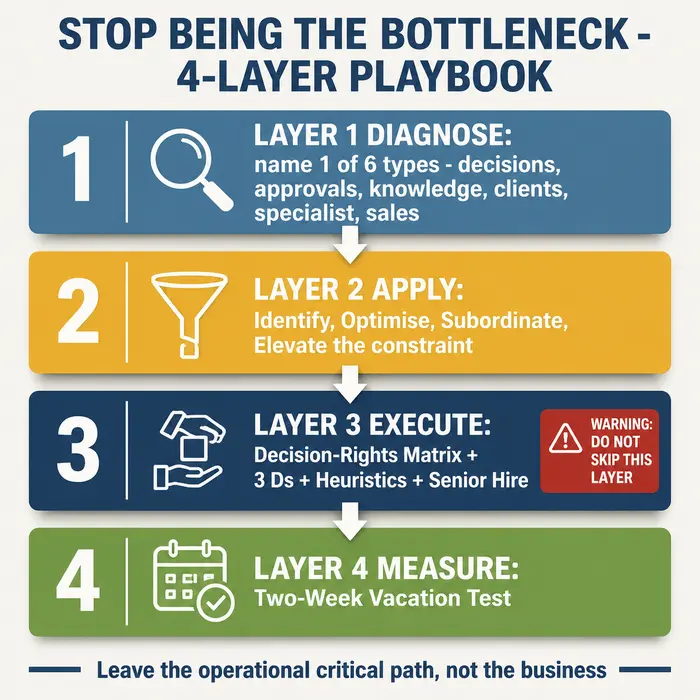
Four layers, run in order — diagnose, apply principles, execute the transfer, measure. They survive contact with your trust issues.
For the full operations stack, see our complete guide to operational efficiency for small business — come back here for the bottleneck-removal sequence.
Why “Delegate More” Already Failed You (and What to Do Instead)
You’ve read the listicles. You’ve tried delegating. You’ve watched ownership snap back the first time something looked off — and you’re suspicious of any article opening by telling you to “trust your team more.”
Your suspicion is correct. Delegation without decision rights and escalation thresholds is just task-routing. You hand the work over, but you still own the decision — so the work still queues behind you. The team learns “you handle this” actually means “you handle this until I get nervous.” Six weeks later, every task is back on your plate.
The reframe changes the maths: the goal is to leave the operational critical path, not the business. Founder involvement in vision, key hires, and brand is appropriate. Founder involvement in approving every refund, signing every quote, and answering every Slack question is the bottleneck. The work below addresses the second category — and only the second category.
Four layers, run in order:
- Diagnose. Name which of the six bottleneck types you actually are.
- Apply principles. Use the four Theory of Constraints rules to set the shape of the fix.
- Execute the transfer. Build the decision-rights matrix, apply the 3 Ds, capture heuristics, and hire someone who can overrule you on their domain.
- Measure. Prove the bottleneck has moved using the two-week vacation test, not your feelings.
Skip Layer 1 and you’ll fix the wrong thing. Skip Layer 4 and you’ll believe yourself fixed when you’re not. Start with diagnosis.
Layer 1 — Diagnose Which Bottleneck You Actually Are
You can’t fix a bottleneck you haven’t named. Owner-operators assume their bottleneck is “everything” — but in practice it sits in one or two of six well-defined categories. Identify yours before you redesign anything.
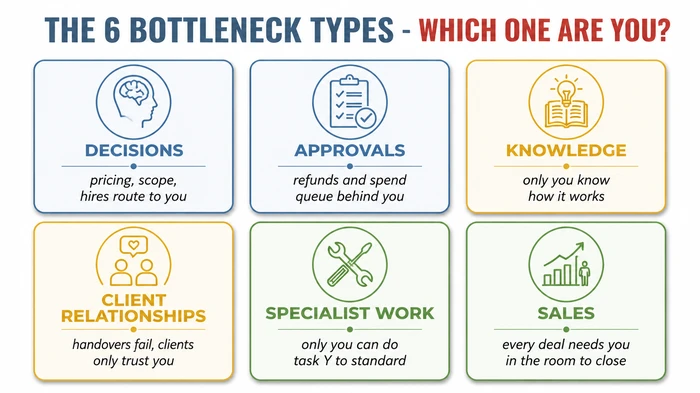
The six bottleneck types:
- Decisions. Recurring trade-offs route to you — pricing calls, scope changes, hiring choices, prioritisation between two competing requests. Symptom: people stop work to “check with you” before they commit.
- Approvals. Sign-offs queue behind you — refunds, discretionary spend, leave requests, content publication. Symptom: your inbox is the slowest step in the workflow.
- Knowledge. Only you know how X is done; nothing is written down. Symptom: people interrupt you with the same questions because the process lives in your head.
- Client relationships. Clients only trust you. Handovers fail because the client escalates back the moment they’re unhappy. Symptom: account managers are titular — every meaningful conversation includes you.
- Specialist work. You’re the only person who can do task Y to the standard the business sells on. Symptom: revenue scales linearly with your billable hours, and the bench can’t help.
- Sales. Every deal needs you in the room to close. Symptom: the pipeline converts at your name, not the salesperson’s.
Run the Bottleneck Self-Diagnosis Scorecard below before reading further — it scores 12 yes/no signals from the last 30 days and maps your answer pattern to the most likely type. The asset is rendered in full in the decision-rights matrix section further down; for now, run a thought-experiment version of the two-week vacation test: if you vanished for 14 days starting tomorrow, what would be the first thing to break? That answer is your bottleneck type.
If you haven’t yet pinpointed where the constraint sits in a specific workflow — as opposed to which category it falls into — run the process-level audit in our companion guide on how to find a business bottleneck before continuing. Process-flow diagnosis and owner-bottleneck diagnosis are complementary; this article assumes the bottleneck is you.
Once you have a type (or two — most operators score on two), the next layer gives you the principles built for managing exactly that.
Layer 2 — Apply the Four Principles of Bottleneck Management (Theory of Constraints)
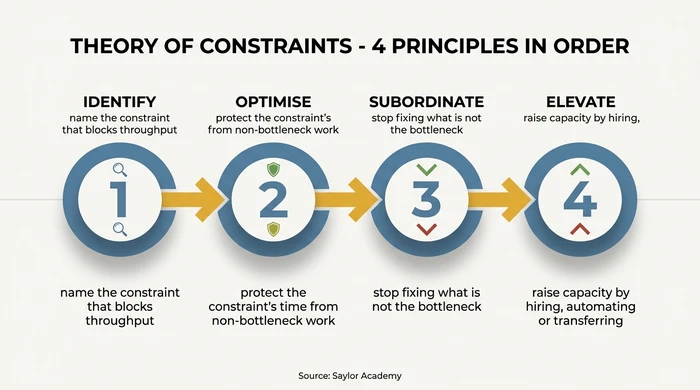
The four principles of bottleneck management, drawn from the Theory of Constraints, are: (1) identify the constraint, (2) optimise the constraint’s use, (3) subordinate everything else to the constraint, and (4) elevate the constraint by raising its capacity. (Source: Saylor Academy.)
Order matters. You can’t elevate a constraint you haven’t identified. You can’t subordinate the rest of the system before you’ve optimised what the constraint already produces. Skipping a step is how operators end up “raising capacity” by hiring before they’ve published a decision-rights matrix — and discover, six months and a salary later, the new hire is also queueing behind them.
Principle 1 — Identify the constraint
When you’re the bottleneck, the constraint isn’t a machine or a department — it’s a category of decisions or a specific specialist task you own. Name it explicitly. “Pricing decisions on bespoke projects” is a constraint. “Things I do” is not. The Layer 1 diagnosis is exactly this step done formally.
Principle 2 — Optimise the constraint’s use
Protect the constraint’s time from non-bottleneck work. If your bottleneck is decisions, the highest-leverage move this week is removing yourself from meetings where you’re not the decider, and refusing to answer questions a published heuristic could answer. The constraint’s time is the most expensive resource in the business — treat it that way.
Principle 3 — Subordinate everything else to the constraint
Reorganise the rest of the team’s work around the constraint. The team’s job becomes preparing decisions for you with their recommendation pre-formed (using your written rules), rather than asking you to decide from scratch. Anything not feeding the constraint or moving work past it is, for now, lower priority.
Principle 4 — Elevate the constraint
Once the first three principles are running, raise capacity. This is where ownership transfer, automation, and senior hires sit. Crucially, this is the last lever — operators who pull it first end up paying for capacity they haven’t yet learned to use.
Principles tell you the shape of the fix. Layer 3 is the execution.
Layer 3 — Execute the Ownership Transfer (Not Just Delegation)
Every operator who’s read this far has previously failed at this layer. Read it twice.
Ownership transfer vs delegation — the distinction that changes everything
Delegation is a task with you retaining ownership: “Please handle this refund request” — when something looks wrong, you take it back. Ownership transfer is a category of decisions permanently re-assigned to a named person with a written escalation threshold: “Refunds under £500 are owned by the Client Lead. Above £500, escalate to me. Below £500, my involvement is a debrief, not a re-decision.”
The distinction isn’t semantic. The first lives in your head and snaps back under pressure. The second is publishable, reviewable, and provably enforced. If you can email it to your team in one paragraph, it’s ownership transfer. If you can’t, you’re still delegating.
Build the decision-rights matrix this week
The single highest-leverage artefact in this entire playbook is a one-page decision-rights matrix listing, for each recurring decision type, the new owner, the escalation threshold, and the review cadence. You’ll publish it to your team by Friday of the week you write it.
Five columns at minimum: decision type, current owner, proposed owner, escalation threshold (£/risk level), and review cadence. The full template — including a worked example covering hiring, spend, refunds, scope changes, technical architecture, marketing approvals, and operational policy — is rendered in the printable utility asset section below. Skip ahead, fill it in for three decision categories before continuing, then come back.
Apply the 3 Ds to one recurring decision type
The 3 Ds — Define, Demonstrate, Delegate — is the operating sequence turning a matrix row into a working transfer. Pick one decision category (we’ll use approving client scope changes under £2,000 as the worked example) and run the sequence end-to-end:
- Define. Write the rule in one paragraph. “Scope changes under £2,000 not reducing margin and which the original Project Lead can deliver within the existing timeline are approved by the Project Lead. Anything above £2,000, anything margin-reducing, and anything affecting the timeline escalates to the founder. The Client Lead is consulted on client-relationship implications but doesn’t approve.”
- Demonstrate. Walk the new owner through the next two real cases fitting the rule. Show your reasoning. Don’t write a hypothetical SOP — the next two real decisions are the SOP.
- Delegate. From decision three onward, the new owner decides without checking. You see the outcome at the weekly review, not before. If the heuristic was unclear, you adjust the heuristic — you don’t retake the decision.
Critically: the discipline isn’t in step three. It’s in not reaching back the first three times you want to. Most owner-operators last about two weeks before they overrule a delegated decision after it’s already been made. The team notices instantly. They notice every time.
Capture heuristics as a by-product of the next 5 real decisions
Don’t write SOPs in isolation. Owner-operators who try to “document everything before changing anything” produce documentation rotting before it ships, because it was written without the friction of a live decision.
Instead: every time you make one of the recurring decisions you intend to transfer, write a one-paragraph heuristic immediately afterwards — the rule of thumb which would have let your team make the same call without you. Five real decisions yield five heuristics. Five heuristics yield a working playbook provably true to your reasoning, because it was extracted from your reasoning.
This is the inverse of the “we should write SOPs” project which has already failed once or twice in the lifetime of your business. Heuristics are written after decisions, not before them.
Hire (or promote) someone who can overrule you on their domain
A junior can’t absorb founder-level judgement. If your bottleneck is decisions of any genuine consequence, the unblock is rarely a cheaper second pair of hands — it’s a senior, a specialist, or a peer who can legitimately overrule you on their domain. EO Network’s framing — “hire people who are better than you” — is right for this stage, even if the headline reads as a cliché.
The diagnostic question is sharp: who on the team would I trust to overrule me on this category if they had a strong reason? If the answer is “nobody,” you’re hiring the wrong roles. Promote internally where you can, and hire externally where you must — but the role specification should pass the overrule test before you write the JD.
The 90-day shadow rule
A decision can only be transferred if someone has done it under your supervision in the last 90 days. If nobody has, that’s the next thing to schedule — not the next thing to delegate. The shadow doesn’t have to be formal training; it has to be the reality the new owner has watched you make this decision recently enough they understand the criteria.
Operators who skip the shadow rule end up with a decision-rights matrix on paper and a queue of escalations in practice, because the named owner has never actually run the play.
The Decision-Rights Matrix (Printable Utility Asset)
Here’s the printable template. Each row takes about 15 minutes. Fill in one row per recurring decision type currently routing through you, swap the GBP examples for your currency, and publish the result to your team by the end of the week.
Use the interactive scorer first to confirm the type of bottleneck you’re actually solving for:
Static fallback (printable scorecard):
| # | Signal (last 30 days) | Bottleneck Type | Tick |
|---|---|---|---|
| 1 | A team member waited more than 24 hours for a decision only you can sign off. | Decisions | ☐ |
| 2 | Work-in-progress sat in your inbox or Slack DMs waiting for your approval. | Approvals | ☐ |
| 3 | Someone asked a question only you could answer because the process is in your head. | Knowledge | ☐ |
| 4 | A client asked for you specifically and refused to deal with anyone else. | Client relationships | ☐ |
| 5 | You did the specialist work yourself because nobody else on the team can. | Specialist work | ☐ |
| 6 | A deal stalled because you were the only person who could close it. | Sales | ☐ |
| 7 | You overruled a team member's decision after they had already made it. | Decisions | ☐ |
| 8 | You signed off a purchase under £500 that did not need your judgement. | Approvals | ☐ |
| 9 | You answered the same operational question from two different people in a week. | Knowledge | ☐ |
| 10 | You worked a weekend because client work was waiting on your input. | Client relationships | ☐ |
| 11 | You cancelled or shortened time off in the last 90 days for an operational reason. | Specialist work | ☐ |
| 12 | The thought of taking two consecutive weeks off without a laptop felt impossible. | Decisions | ☐ |
Scoring bands:
- 0-1 ticked: Low signal. Re-run after a busy fortnight to confirm.
- 2-4 ticked: Early-stage bottleneck. Fix the pattern before it compounds.
- 5-8 ticked: Confirmed bottleneck. Move on ownership transfer in the next 14 days.
- 9-12 ticked: Severe. You are the operational critical path. Build the decision-rights matrix this week.
The bottleneck type with the most ticks is the layer to attack first.
The decision-rights matrix template. Fill one row per recurring decision type currently routing through you. Spend thresholds in the example use GBP — swap to your currency. The “Escalate to founder” column is the line above which the decision still comes back to you; below it, the Owner decides without checking.
| Decision Type | Current Owner | New Owner (named person) | Consulted (optional) | Threshold for Owner Authority | Escalate to Founder When | Review Cadence |
|---|---|---|---|---|---|---|
| Hiring (junior / mid) | You | [Ops Lead] | Hiring manager | Salary ≤ £45k, within approved headcount | Above £45k, or new role not in plan | Quarterly |
| Discretionary spend | You | [Department head] | Finance | Single line ≤ £1,000, monthly ≤ £5,000 | Single line > £1,000 or recurring contract | Monthly |
| Client refunds / goodwill credits | You | [Client Lead] | - | Refund ≤ 20% of monthly fee | Refund > 20% or contract termination | Monthly |
| Scope changes on live projects | You | [Project Lead] | Client Lead | ≤ 10% of original scope, no margin loss | > 10% scope or any margin reduction | Per project |
| Technical architecture decisions | You | [Senior Engineer / Tech Lead] | Founder (informed only) | Reversible within 1 sprint | Multi-quarter commitments, vendor lock-in | Quarterly |
| Marketing / content approvals | You | [Marketing Lead] | - | On-brand, fits published voice guide | New positioning, paid spend > £2,000 | Monthly |
| Operational policy changes | You | [Ops Lead] | Affected team leads | Reversible, single-team scope | Cross-team or compliance-affecting | Quarterly |
| [Add your own] | You | [Named person] | - | [Threshold] | [Escalation rule] | [Cadence] |
Publication rule: This matrix is worthless if it lives in your head or your Notion drafts. Publish it to the named owners by Friday of the week you write it. Re-review at the cadence in column seven.
“Should I Be the One Doing This?” — Visual Decision Tree
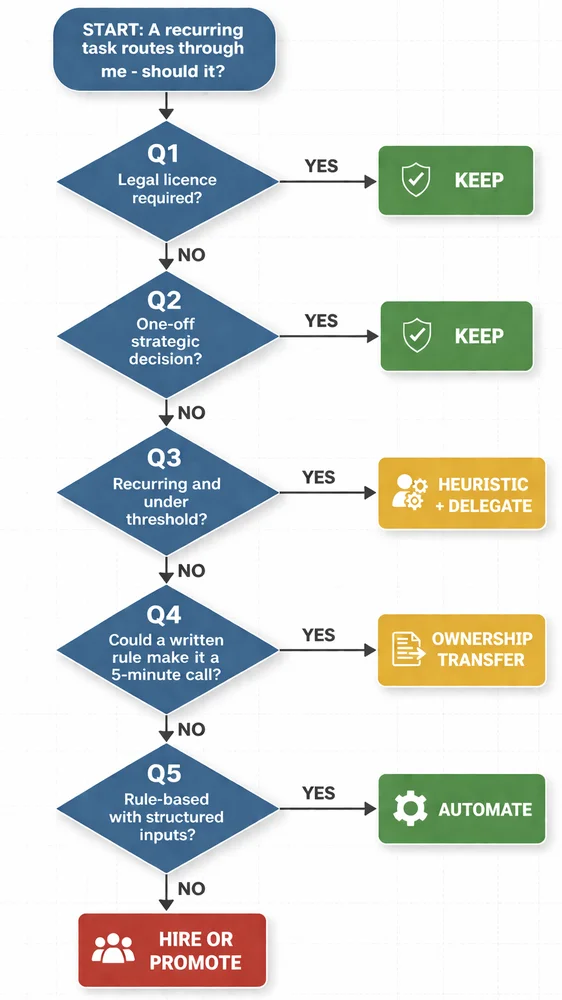
Run any task still routing through you through the five-question tree below. The terminal node names one of five actions: keep it, write a heuristic and delegate, transfer ownership, hire or promote, or automate. The tree mirrors the principles in Layer 2 — it’s the operator-level view of identify-optimise-subordinate-elevate, applied one task at a time.
| Scenario (Answer Pattern) | Action | Reasoning |
|---|---|---|
| Q1 YES - Task legally requires your licence, signature, or named authority (clinical sign-off, regulated financial advice, partner sign-off on legal opinion). | KEEP. Schedule and protect the time. | Some sign-offs are not bottlenecks - they are the job. The fix is to batch and protect the time, not transfer the work. |
| Q1 NO → Q2 YES - One-off strategic decision (vision, key hire, brand voice, founding investor terms). | KEEP. Make the decision without delay. | Founder judgement on irreversible strategic moves is correct ownership. Removing yourself here is over-correction. |
| Q1 NO → Q2 NO → Q3 YES - Recurring decision, under your monetary or risk threshold. | HEURISTIC + DELEGATE. Write the rule of thumb, name the owner. | Recurring small-stakes decisions are the highest-volume bottleneck. A one-paragraph heuristic turns a 30-minute escalation into a 5-minute decision for the new owner. |
| Q1 NO → Q2 NO → Q3 NO → Q4 YES - Recurring decision above the threshold, but a written heuristic could make it a 5-minute call for someone else. | OWNERSHIP TRANSFER. Re-assign the category permanently with documented escalation rules. | Above-threshold recurring decisions need formal ownership transfer, not delegation. The written escalation rule is what stops the work snapping back the first time something looks wrong. |
| Q1 NO → Q2 NO → Q3 NO → Q4 NO → Q5 YES - Recurring task, but nobody on the team has done it under your supervision in the last 90 days. | HIRE OR PROMOTE. Bring in a senior or specialist who can overrule you on this domain. | You cannot transfer ownership to a person who does not exist or does not yet have the judgement. The unblock is the hire, not more delegation attempts. |
| Q1 NO → Q2 NO → Q3 NO → Q4 NO → Q5 NO - Task is recurring, rule-based, and inputs are already structured (data entry, scheduling, basic invoicing, status updates). | AUTOMATE. Move it to a tool or workflow before assigning a human. | Rule-based recurring work is the cheapest category to remove from the critical path. Hiring a human to do it just relocates the bottleneck. |
Layer 4 — Measure It (The Bottleneck Has Only Moved If the Data Says So)
Most “I fixed my bottleneck” stories revert within a quarter — because the operator measured the fix using their own feelings. “I feel less busy” isn’t a measurement. The team’s calendar is.
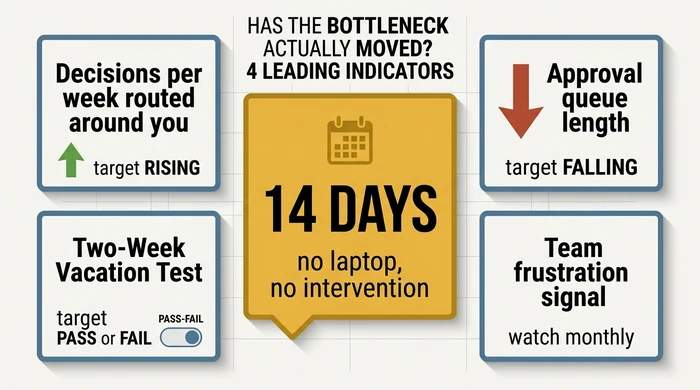
The two-week vacation test is the lagging indicator: 14 consecutive days during which you don’t approve, decide, or specialist-deliver. The first time you run it, run it as a thought experiment — what would break, who would call you, which decisions would queue? The second time, run it for real. Book the flights, set the auto-responder, and hand over a printed copy of the decision-rights matrix. If the business doesn’t survive 14 days without you intervening, the bottleneck hasn’t actually moved.
Leading indicators — the metrics you watch weekly while you build toward the vacation test:
- Decisions per week routed around you. Target: rising week-on-week. Count anything the team decided and informed you of after the fact, where six months ago they would have asked first.
- Approval queue length in your inbox. Target: falling. The simplest proxy — count items waiting on your sign-off at the end of each Friday.
- Number of heuristics published this month. Target: at least 2. Each heuristic is a permanent removal of an escalation class.
- Team members who have made a >£1,000 call without you this week. Target: at least 1. If nobody has, the matrix is still theatre.
The anti-metric. If your only evidence the bottleneck has moved is you “feel less busy,” it hasn’t moved. Founders feel less busy for many reasons having nothing to do with capacity transfer — the season is quiet, you’ve stopped looking at one part of the business, you’ve learned to ignore the queue. Trust the indicators, not the feeling.
Warning — Four Things That Will Break the Transfer (Anti-Advice)
1. Do not “just delegate more.” Without a written decision-rights matrix and named escalation thresholds, delegation snaps back the first time something looks wrong. The team learns “you handle this” actually means “you handle this until the founder gets nervous.” If you can’t email the rule in one paragraph, you’re still delegating, not transferring.
2. Do not hire a junior to “take things off your plate.” A junior can’t replace founder-level judgement on the decisions bottlenecking you — they’ll defer to you, and you’ll be doing the same job at a higher headcount. The unblock is a senior, a specialist, or a peer who can credibly overrule you on their domain. Hire (or promote) for the overrule test, not the workload test.
3. Do not document everything before changing anything. SOPs written in isolation rot before they ship. Capture heuristics as a by-product of the next 5 real decisions, not as a 6-week documentation project. The rule of thumb is written after the decision, not before.
4. Do not equate “I am still needed” with “I am still the bottleneck.” Some founder involvement is correct — vision, key hires, brand voice, regulated sign-offs. The goal is to leave the operational critical path, not the business. Confusing “needed” with “blocking” causes founders to over-correct, abandon legitimate ownership, and create a new set of problems on top of the old one.
Variations & Exceptions
The default playbook above assumes you’re an owner-operator with hire/fire authority and a small team. The four scenarios below adjust the advice for the most common edge cases.
If you’re a salaried manager (engineering manager, IT manager, ops lead), not a founder, then you can’t hire your way out. Push for explicit decision-rights re-allocation upward (your own manager) and downward (your team leads). Use the same matrix; the difference is the conversation preceding it. Frame it as risk reduction for the business, not relief for you.
If you’re a solo operator with no team yet, then “stop being the bottleneck” means productisation, automation, or making the first hire — delegation isn’t on the table because there’s nobody to delegate to. Identify the one task which, automated or productised, would free 8 hours a week. Build it first. Hire only when you have a defensible spec for what the new person owns from day one.
If you run a client-facing service business (agency, salon, clinic) where you ARE the brand, then expect a brand-trust transfer problem on top of the process problem. Plan a 90-day handover running you and the new owner in parallel on each major client account. The handover is complete when the client emails the new owner first, not when you’ve stopped attending the meetings.
If a decision is regulated or safety-critical (clinical, legal, financial sign-off), then it legitimately must route through the licensed person. Distinguish “I should not delegate this” from “I have not delegated this yet.” Don’t transfer regulated approvals — instead, batch and protect the time so the regulated work doesn’t block unregulated work.
Frequently Asked Questions
Q: How do you remove yourself as the bottleneck at your company?
Run the four-layer playbook in order. First, diagnose which of the six bottleneck types you are (decisions, approvals, knowledge, client relationships, specialist work, or sales). Second, apply the four Theory of Constraints principles — identify, optimise, subordinate, elevate. Third, execute ownership transfer using a written decision-rights matrix with named owners and escalation thresholds. Fourth, prove the fix with the two-week vacation test. Skip any layer and the bottleneck snaps back within a quarter.
Q: What are the 4 principles of bottleneck management?
The four principles, drawn from the Theory of Constraints, are: (1) identify the constraint — name what’s actually limiting throughput; (2) optimise the constraint’s use — protect its time from non-bottleneck work; (3) subordinate everything else to the constraint — reorganise the rest of the system to feed it; (4) elevate the constraint — raise capacity by hiring, automating, or transferring ownership. Order matters; you can’t elevate before you identify.
Q: How do you overcome bottlenecks in business?
Distinguish the two types first. Process bottlenecks (a slow machine, a single overloaded department, a queueing handover) are solved with workflow redesign — see our companion guide on how to find a business bottleneck. Owner bottlenecks (you, the founder, blocking decisions and approvals) are solved with the four-layer playbook above. Most owner-operators reading this article have the second type. The treatment is different.
Q: What does it mean to prevent bottlenecks?
Prevention means building decision rights, heuristics, and capacity before throughput hits the ceiling, not after. In practice: publish a decision-rights matrix when the team is still small enough to hold the whole picture in your head, capture heuristics as a by-product of every recurring decision, and hire one role ahead of need, not one role behind. Prevention is a habit, not a project — the operators who don’t become bottlenecks are the ones who never let the work centralise in the first place.
Q: What are the 3 Ds of delegation?
Define, Demonstrate, Delegate. Define the decision rule in one paragraph (the heuristic). Demonstrate it by walking the new owner through the next two real cases — show your reasoning live, don’t write a hypothetical SOP. Delegate from case three onward; the new owner decides without checking, and you see the outcome at the weekly review. The discipline is in not retaking the decision the first three times you want to.
Q: I have already tried delegating and it failed — what do I do differently?
Switch from delegation to ownership transfer, and build the matrix first. Delegation hands over a task while you keep the decision rights — which is why the work snaps back the moment something looks wrong. Ownership transfer permanently re-assigns a category of decisions to a named person with a written escalation threshold, so the rule is enforceable on both sides. Pick one decision category this week, write the rule, name the owner, publish it, and hold the line for the first three cases.
Conclusion — Build the Matrix. Run the Test.
The signature measurement is the two-week vacation test: 14 consecutive days during which you don’t approve, decide, or specialist-deliver. If the business can’t survive that, the bottleneck hasn’t moved — regardless of how much less busy you feel.
Removing yourself from the operational critical path isn’t the same as stepping back from the business. Vision, key hires, and brand voice are correct founder ownership. Approving every refund and signing every quote is the bottleneck. The point of this work is to get one back, not lose the other.
Your next 7 days, in order:
- Score the 12-signal Bottleneck Self-Diagnosis Scorecard above. Identify which one or two bottleneck types describe you.
- Draft the decision-rights matrix for three decision categories. Name the new owner, the escalation threshold, and the review cadence. Publish it to the team by Friday.
- Write your first heuristic from the next recurring decision you make. One paragraph. Save it where the team can find it.
Come back to the operational-efficiency hub for the rest of the operations stack — staffing, systems, financial controls — once the matrix is live and the first vacation test is on the calendar.
Founder, Too Many Hats
Free tool
What it's costing you
See how many hours your manual tasks are really costing you.
Free tool
Problem Solver
Describe your biggest timewaster and get a personalised plan.
Related Guides
Data Silos in Small Business: Why Your Tools Don't Talk
Stop reconciling reports every Sunday. What data silos look like in a 5-50 person business, the silo tax they cost you, and the 30-90 day fix.
Build Business Systems That Run Without You
Build business systems that run without you: a 6-step framework, decision tree, worked customer-onboarding example, SOP template, and AI prompt.
How to Find the Bottleneck in Your Business (Diagnostic)
Find the bottleneck in your business in one afternoon with a 4-step diagnostic, Little's Law worksheet, and decision tree. No software required.