Hire or Systematize Your Business: Founder's Decision
Stuck choosing whether to hire or systematize your business? Use this 8-question decision matrix to pick the right move this week — not next quarter.
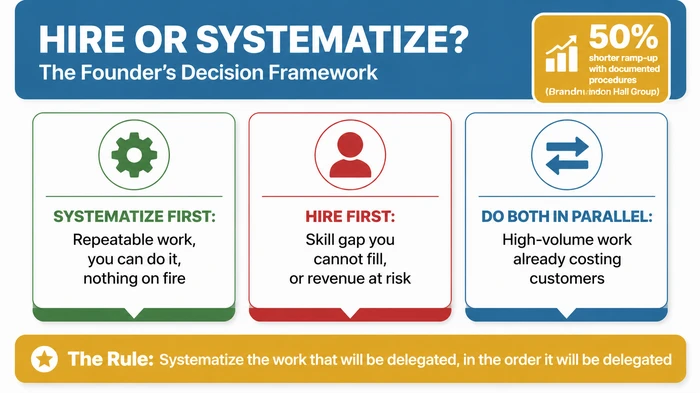
The Verdict: The right move between hiring and systematizing your business depends on the bottleneck: systematize first when the work is repeatable and you can do it; hire first when the bottleneck is a skill you lack or live revenue is at risk; do both in parallel when high-volume repeatable work is already costing you customers.
Critical Insights:
- Documented procedures cut new-hire ramp-up time by 50% (Brandon Hall Group) — but only when the SOPs cover work the new hire will actually touch.
- A premature hire without systems typically consumes 60-90 days of founder time before producing net-positive output, often costing £8k-£20k in salary plus lost founder hours.
- Document only the 3-5 systems the next hire will touch in their first 30 days — not the 4, 7, or 9 generic lists pushed by coaching pages.
- Hire first (not systematize first) when the bottleneck is a skill you genuinely cannot perform yourself, or when delivery is currently slipping with paying customers.
- A solo founder writing SOPs with no named delegation target is doing theatre, not operations — systems pay back at the moment of delegation, not before.
You’re stuck on whether to hire or systematize the business. Pick wrong and you burn 90 days.
A premature hire watches you work because nothing’s written down. A premature SOP sprint produces 40 pages nobody will ever read because the role they were written for never gets filled. Either mistake costs the same: a quarter of the year, gone.
This guide gives you a written decision matrix, eight diagnostic questions, and three rulings — SYSTEMATIZE FIRST, HIRE FIRST, DO BOTH IN PARALLEL — so you can pick the right move this week instead of next quarter.
Why “Hire or Systematize?” Is the Wrong Question
The question itself is the trap. You arrived stuck because you accepted a binary choice which doesn’t exist in the real world, and the standard advice — “always systematize first” — is a coach’s slogan, not an operating principle. Most top-ranking pages on this topic default to systematize-first without naming the conditions where the advice is actively dangerous. This article is part of our complete guide to operational efficiency for small business, and it exists because the binary framing is the single biggest reason founders waste a quarter of the year on the wrong move.
The right question isn’t “hire or systematize?” It’s “what is my bottleneck, and which move clears it fastest at acceptable risk?”
Four variables decide the answer. Get these clear before anything else:
- Skill gap. Is the bottleneck work you genuinely cannot do, or work you can do but lack time for?
- Revenue at risk. Is delivery currently slipping with paying customers, or are customers still being served while you hit your own ceiling?
- Repetition rate. Does the bottleneck work recur at least three times per month, or is it a one-off shape every time?
- Prior hire failure. Has a previous hire failed at this kind of work, suggesting the missing piece was the system rather than the person?
Each of those four variables maps to a question in the diagnostic later. Scoring them honestly takes about five minutes, and the answer almost always points one direction. The reason the question feels paralysing isn’t because the answer is hard. It’s because nobody has bothered to write the variables down for you.
Before you can score any of them, you have to name the bottleneck. Here’s how.
Name the Bottleneck Before You Choose the Move
Founders skip this step and pay for it later. The four-minute exercise below turns vague overwhelm into a single-sentence constraint the rest of the framework can act on.
Write your bottleneck in this exact format:
“I am stuck because [specific work] is taking [X hours/week] and only I can do it.”
That’s the rule. One sentence, three variables, no qualifiers. “I am stuck because client onboarding is taking nine hours a week and only I can do it.” Works. “I’m stuck because everything is overwhelming” doesn’t — there’s no work to delegate, no hours to reclaim, no decision to make.
Common bottleneck shapes for the founder at the capacity ceiling:
- Delivery throughput. The core work the customer is paying for, capped by your hands.
- Client onboarding. The first two weeks of a new engagement, ad-hoc and undocumented.
- Sales follow-up. Proposals, contracts, and the gap between “yes” and “signed”.
- Admin and finance. Bookkeeping, invoicing, supplier reconciliation — the things which have to happen but never feel urgent until they are.
- Technical work the founder genuinely cannot do. A different category — flag it now and read the HIRE FIRST section below.
If you haven’t yet identified your bottleneck cleanly, start with our guide on how to find your business bottleneck and come back. The framework breaks if you try to fix three bottlenecks at once. Pick the single constraint capping output now.
A note on tribal knowledge: every founder at this stage has it, and it’s the silent reason most cannot delegate even after they hire. Tribal knowledge is operational know-how living in your head and never written down — the “oh, and for that client we always…” rules which turn a fresh-faced VA into a question machine for 60 days. Naming the bottleneck is the first step in dragging tribal knowledge into the open. If the bottleneck work is also work you’ve never written down, you’ve just found your delegation candidate. (For founders who suspect their own habits are part of the problem, the stop being the bottleneck guide goes deeper into the mindset side.)
One sentence. Then move to the matrix.
The Hire-or-Systematize Decision Matrix
The matrix runs on a single prioritisation rule, and the rule is the differentiator from every coaching page on the first page of Google: systematize the work which will be delegated, in the order it will be delegated. Not by importance. Not by frequency. By delegation order. The first hire’s first task gets the first SOP. Everything else waits.
Three rulings come out of the matrix:
- SYSTEMATIZE FIRST — repeatable work, you can do it, no live revenue at risk. Document now and the eventual hire ramps up at half the cost.
- HIRE FIRST — skill gap you cannot fill, OR live revenue at risk from delays. The hire either supplies the missing capability or buys you back time you don’t have.
- DO BOTH IN PARALLEL — high-volume repeatable work with revenue at risk. Document while you recruit. Hardest to execute, sometimes the only correct move.
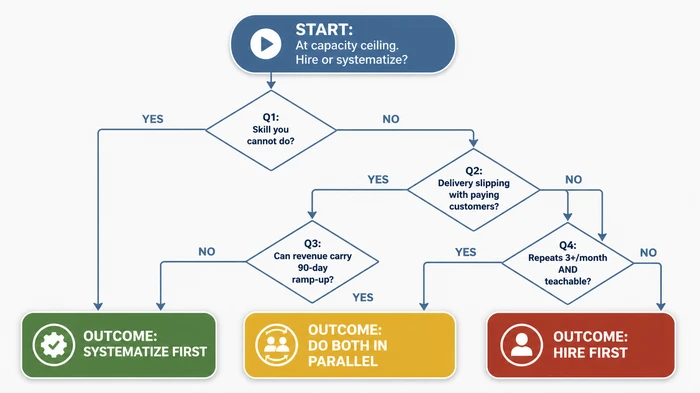
Use the interactive scorer below to score your own bottleneck against the eight diagnostic questions. Answer all eight and the ruling appears at the bottom. If you have JavaScript disabled, the static decision matrix following the scorer covers the same logic in table form.
If the scorer is unavailable, score yourself against the static matrix below. Same logic, fewer dropdowns.
| Scenario | Skill gap? | Revenue at risk? | Repetition | Ruling | Why |
|---|---|---|---|---|---|
| Founder lacks the skill (tax, code, design beyond their level) | Yes | Any | Any | HIRE FIRST | You cannot document what you cannot do. The hire writes the SOPs. |
| Customers slipping now, high-volume work, budget for ramp-up | No | Yes | 10+/month | DO BOTH IN PARALLEL | Recruit and document on the same 30-day clock. The hire lands into a partial system. |
| Customers slipping now, no budget for a 90-day ramp-up | No | Yes | Any | SYSTEMATIZE FIRST | Documentation is the cheapest hours-back move. A premature hire makes the cash worse. |
| Previous hire failed at this work; work is teachable | No | No | 3+/month | SYSTEMATIZE FIRST | Prior failure usually signals missing system, not missing person. Fix the system, then re-hire. |
| Repeatable work, founder can do it, nothing on fire | No | No | 3+/month | SYSTEMATIZE FIRST | Documented procedures cut new-hire ramp-up time by 50% (Brandon Hall Group). Build before you hire. |
| Low-repetition work, budget exists, founder can do it | No | No | 1-2/month | HIRE FIRST | Not enough volume to justify a documentation sprint. A capable hire shapes the role and writes systems as they go. |
| Mixed signals, no clear dominant constraint | No | Mixed | Mixed | DO BOTH IN PARALLEL | Open the role at low urgency, start light documentation. Re-score in 30 days. |
Score honestly. The matrix returns one of three rulings. The next three sections tell you what to do under each.
When to Systematize First (and How — the Reconciled Pre-Hire Systems List)
This is the path for the 80%. If your bottleneck is repeatable work you can do, no customer is currently slipping, and the work recurs at least three times per month, you systematize first. The reasoning is mechanical: documented procedures reduce eventual ramp-up time by 50% (Brandon Hall Group), and the cheapest founder hours you’ll ever buy back are the ones you reclaim by templating your own work before anyone else gets near it.
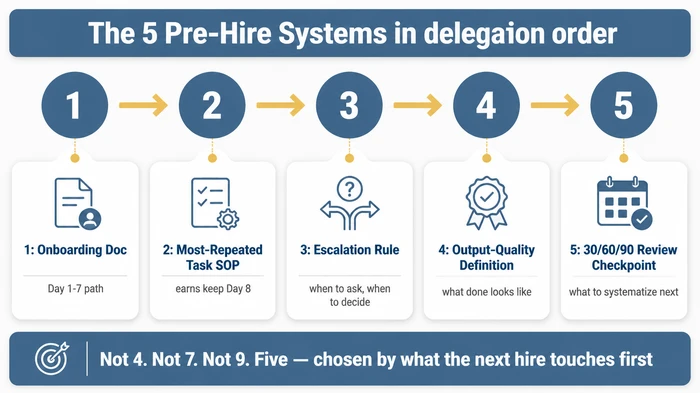
The hard part isn’t the whether. It’s the what. Coaching pages disagree wildly: Harrison says four systems before you hire, systemhub says seven, Forbes says nine. They’re all wrong by being arbitrary. The reconciled answer is five systems, chosen by a single rule:
Document the work the next hire will touch, in the order they will touch it.
The list:
- Onboarding doc (Day 1-7 path). What the new hire reads, watches, and does in their first week. One page. Includes login list, who-does-what map, and the first three tasks they’ll own. Earns its keep on Day 1.
- The single most-repeated task SOP. The work they’ll do most often, recorded as a Loom plus a one-page written summary. Earns its keep on Day 8.
- The escalation rule. When to ask, when to decide alone, when to flag to the founder. Three bullets, no more. Earns its keep the first time they hit something unexpected.
- The output-quality definition. What “done” looks like for the work they own — one example of acceptable output, one example of unacceptable. Earns its keep at their first review.
- The 30/60/90 review checkpoint. Three short check-ins on the calendar before they start. Each has three questions: what worked, what is unclear, what to systematize next.
That’s it. Anything beyond these five is theatre until the hire arrives and tells you what they actually need. Each later SOP gets written with the hire, in response to a real question, not in advance against an imagined one. (For deeper guidance on building each system from scratch, see how to build business systems.)
How to write them fast: Loom yourself doing the work in flight, send the recording to a transcription service, then spend 30 minutes editing the transcript into a one-page SOP. AI is useful at the transcript-compression step. AI isn’t a substitute for recording the actual work. “Use AI to generate your SOPs” is one of the four mistakes costing founders a quarter of the year — covered in the warning section below — because the tribal knowledge edge cases which are the actual reason the work is stuck in your head are invisible to a model that has never seen you do the job.
Time estimate for a focused founder: 2-4 weeks to ship all five, working at roughly 8-10 hours per week on documentation. If your honest estimate exceeds 6 weeks, the bottleneck is too broadly scoped — re-scope down to one role’s worth of work and re-run the matrix.
When to Hire First (the Contrarian Case)
Every coaching page on the first page of Google defaults to systematize-first. The advice isn’t wrong; it’s incomplete. There are three conditions under which hiring first is the correct move, and naming them is the wedge against the standard advice.
Condition 1: Skill-gap bottleneck. You cannot systematize what you cannot do. If the bottleneck is tax work you don’t understand, code at a level beyond you, design judgement you don’t possess, or any regulated specialism, hiring is the only move that adds the missing capability. The hire writes their own SOPs with your business context as input. Trying to document the work yourself produces guesses the eventual hire has to throw away. Skip the documentation sprint and go straight to recruiting.
Condition 2: Revenue-at-risk bottleneck. Delivery is currently slipping with paying customers and the cost of a 60-day systematizing sprint exceeds the cost of a fast hire-and-train. This is a math problem disguised as a strategy problem. If you lose two clients while you write SOPs, you’ve spent £20k on documents to save £8k on ramp-up. The math demands a hire, even if it costs more in absolute terms.
Condition 3: A genuine emergency. Your top customer’s account manager just quit and you’re on the hook for delivery in 14 days. Documents written next week are useless because they won’t be read until week three of someone else’s tenure you haven’t started recruiting for. Get a contractor in this week. Document with them as you go.
The compromise in all three cases: hire first, document with the new hire as you go. Their first questions become your SOPs. You trade some of the 50% ramp-up reduction for time-to-revenue, and the trade is worth it because the alternative is worse.
One caveat. “Skill gap” is the most-abused get-out clause in the small-business advice industry. It applies to this hire, not all hires. If your bottleneck is repeatable admin work and you tell yourself it’s a skill gap because you find QuickBooks tedious, you’re looking for a reason to skip the documentation work for the rest of the business. Tedium isn’t a skill gap. Be honest with yourself before you reach for this exit.
When to Do Both in Parallel
The third ruling. Rarer than either pole, harder to execute, and sometimes the only correct move.
This applies when you have high-volume repeatable work and revenue at risk. The classic shape: a service agency at the capacity ceiling, recruiting an account manager while delivery is currently slipping with two existing clients. Either pure path fails — systematize-first loses the slipping clients, hire-first dumps a new person into an undocumented mess and they quit in 90 days.
The split that works: 60% of your founder week on documentation of the next hire’s first 30 days, 40% on recruiting and interviewing. Documentation doesn’t need to be polished before you post the ad — it needs to be good enough for a competent newcomer to follow with two questions a day by their start date. That bar is lower than founders assume, and shipping to it is achievable in 3-4 weeks.
The honest cost of this ruling is that it’s the hardest of the three to execute. You’re doing two unfamiliar things at once — recruiting (for most founders, a once-a-year activity) and writing operational documentation (for most founders, a never activity). Most founders fail this ruling by over-investing in one track and starving the other. The most common failure shape is “I’ll just get the recruiting going first, then write the SOPs” — and the SOPs never get written because by the time the hire arrives, you’re answering their questions live and there’s no slack to write anything down.
Decision rule: if you cannot honestly commit 8 hours per week to documentation while recruiting, drop back to HIRE FIRST and accept the higher ramp-up cost. Don’t pretend you can do both when you can’t. The pretence is more expensive than the honest fallback.
The Cost of Getting It Wrong
Three failure modes. Quantified, in order of how often they happen.
The premature hire. You hired before the work was scoped, the role was defined, or the first 30 days of tasks were documented. Salary plus onboarding plus founder hours spent answering basic questions runs £8k-£20k in the first 90 days for a UK SME first-operational-hire scenario, before you count opportunity cost. The Brandon Hall ramp-up data is the dominant variable here — without documented procedures, ramp-up takes twice as long, and the founder hours which should have been clawed back instead get spent supervising. This is the visible failure mode because the cash leaves the bank account.
The premature SOP sprint. You spent 40-80 founder hours writing documents for a role which never gets filled. SOPs without a named delegation target decay within 90 days because the work shifts faster than unread documents update. The opportunity cost is the lead you turned away in week three of the sprint, plus the lead you turned away in week six, plus the customer who slipped because you were busy writing instead of delivering. The cash damage is invisible (no salary went out the door), which is why this failure mode runs unchallenged in coaching circles.
The freeze. You did neither for six months while the bottleneck worsened. This is the modal failure mode — the most common of the three — and the most expensive because the cost compounds. Each month you stayed at the capacity ceiling, you turned away another lead, watched another customer drift, and added another fortnight of personal exhaustion to the run-rate. The freeze costs more than a premature hire and a premature SOP sprint combined, because at least those two produce something — a person with the wrong skills, a stack of documents nobody reads. The freeze produces nothing except the calendar quietly emptying.
A fourth, smaller cost worth naming: a bad first operational hire, when you do hire, runs 30-50% of annual salary in re-recruit, retraining, and lost output by the standard small-business rule of thumb. That’s the cost the matrix is designed to prevent. Run the diagnostic. Take the ruling. Don’t freeze.
Variations & Exceptions
The framework above covers the 80% of founder situations. Five edge cases force a different read:
- If the bottleneck is a skill you genuinely cannot do (tax, code, regulated specialism): hire first regardless of repetition rate. You cannot document what you cannot perform.
- If delivery is currently slipping with paying customers: revenue at risk overrides systematize-first. Hire fast, document with the hire as their questions surface the gaps.
- If the work genuinely changes shape every engagement (one-off creative, novel R&D): systematize the meta-process — intake, scoping, sign-off — not the work itself. The variable work stays variable; only the wrapper around it gets a system.
- If you are a solo founder with no near-term hire planned: building SOPs for an imagined hire is theatre. Build personal checklists for yourself. Convert them to SOPs at the point of delegation, not before.
- If you operate in a regulated industry (healthcare, finance, legal): some systematization is compliance-driven and non-optional regardless of headcount. Treat it as a separate workstream from the hire-vs-systematize decision and run both in parallel without trying to fold them together.
The Anti-Advice — Common Mistakes to Avoid
The internet is full of confident, one-line answers to “should I hire or systematize?” Four of them, all popular, all wrong for a founder at the capacity ceiling.
1. “Just hire a VA, you’ll figure the systems out as you go.”
With no documented work to hand over, the VA spends their first month asking questions and you spend it answering. Net loss of founder hours. You paid a salary to make your week worse. → Document the first 30 days of the role before posting the ad.
2. “Document everything before you hire anyone.”
SOPs written for work nobody will ever do are theatre. They go out of date in 90 days, the delegation target never arrives, and you end up with a Notion graveyard instead of capacity. → Document only the 3-5 systems the next hire will touch.
3. “Use AI to generate your SOPs.”
AI cannot capture the tribal knowledge edge cases which are the actual reason the work is stuck in your head. You’ll get a plausible-looking document failing on the first non-standard customer. → Record yourself doing the work (Loom), transcribe it, then use AI to compress the transcript. AI is a transcription accelerant, not a substitute for recording the work.
4. “Hire someone senior who’ll build their own systems.”
Sometimes correct (genuine skill-gap case). Mostly used to avoid the documentation work entirely. Most senior hires inherit chaos badly, look around for 60 days, then quietly start updating their LinkedIn. → Reserve this play for genuine skill gaps. Don’t use it as a blanket excuse.
Red flags to watch for in your own behaviour this week:
- You’re writing SOPs for a role you haven’t scoped, with no candidate in mind, and no start date.
- You’re about to post a job ad for work you’ve never written down.
- You’re pasting “write me an SOP for client onboarding” into ChatGPT before you’ve done a Loom of yourself doing it once.
- You’re interviewing senior candidates and the words “they will figure it out” appear in your own head.
If two or more of those describe your last 7 days, stop. Run the diagnostic above before the next move.
This Week’s Move
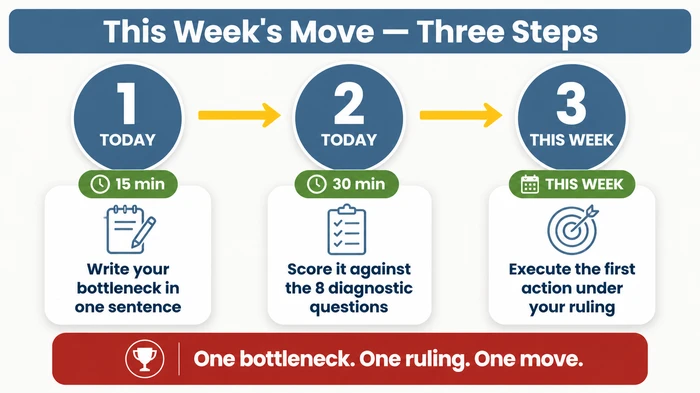
Three steps, in order, on the calendar:
- Today (15 minutes). Write your bottleneck in one sentence using the “I am stuck because [work] is taking [X hours/week] and only I can do it” format from the second H2.
- Today (30 minutes). Score it against the eight diagnostic questions in the matrix above. Take whichever ruling the matrix returns. Don’t argue with it.
- This week. Execute the first action under your ruling — not all five things you read on LinkedIn this week. One ruling, one move, one week.
The prioritisation rule, one final time: systematize the work which will be delegated, in the order it will be delegated. Everything else is noise.
Frequently Asked Questions
Q: What does it mean to systematize a business?
To systematize a business means converting the work you currently do from memory and habit into documented, transferable processes someone other than you can follow. The output is a set of written or recorded SOPs — Standard Operating Procedures — capturing the actual steps, decisions, and judgement calls of repeatable work, so the work can be delegated without you supervising every move.
Q: How do you systematize your business?
Follow four steps in order. First, name the single bottleneck in one sentence. Second, identify the 3-5 systems the next hire will touch in their first 30 days — not 4, 7, or 9 generic systems. Third, Loom-record yourself doing each one in flight, then transcribe. Fourth, edit the transcript into a one-page SOP and review it after the first delegation cycle. The order matters: documenting work nobody will ever delegate is theatre.
Q: What is an example of systematizing a business?
Yes — here is the canonical small-agency example. The owner is the only person who onboards new clients, and onboarding takes nine hours per engagement spread across two weeks of ad-hoc Slack messages. They Loom-record the next two onboardings in full, edit the transcripts into a six-step intake flow with a template checklist, and hand the checklist to a junior account manager in week one of their tenure. The junior runs the next onboarding solo with two clarifying questions. Total founder time on onboarding drops from nine hours to one hour per client.
Q: Should I hire or systematize first?
Systematize first if the bottleneck work is repeatable, you can do it, and no customer is currently slipping. Hire first if the bottleneck is a skill you genuinely cannot do, or if delivery is currently slipping with paying customers and revenue is at risk now. Do both in parallel if high-volume repeatable work is already costing you customers. Run the eight-question diagnostic above to score your specific situation.
Q: How many systems should I document before hiring?
Document 3-5 systems before your first operational hire — chosen by the rule “what the next hire touches in their first 30 days”, not by an arbitrary count. The popular 4-system, 7-system, and 9-system lists circulating in coaching content are based on imagined comprehensiveness rather than actual delegation order. Five well-chosen systems aimed at one specific role beat nine generic systems aimed at no one.
Conclusion
Systematize the work which will be delegated, in the order it will be delegated. Run the diagnostic. Take the ruling. Make the move that matches your actual bottleneck this week — not the one that matches the LinkedIn post you read this morning. The rest of the operational-efficiency picture lives in the broader guide, but the move that unsticks you is the one above. Go make it.
Founder, Too Many Hats
Free tool
What it's costing you
See how many hours your manual tasks are really costing you.
Free tool
Problem Solver
Describe your biggest timewaster and get a personalised plan.
Related Guides
AI Sales Follow Up: Stop Ghosting Your Warm Leads
AI sales follow up for founder-sellers: score leads, fire triggers, draft the first touch, and call the right lead today — without burning your domain.
AI Customer Service for Small Business: 3 Modes, 30-Day Path
AI customer service for a small business in three modes — deflection, routing, AI assist — plus the handover seam that protects quality. 30-day path.
How to Reduce Errors in Business Processes (Forensic Guide)
Reduce errors in repetitive business processes with a three-lever sequence: redesign, automate, protect. Scorecard, worked example, 5 rights pattern.