Automate Employee Onboarding for Small Business: Steps
Automate employee onboarding for small business: pre-boarding workflows, IT provisioning, training, and budget-tiered tools you can deploy this month.
How to Automate Employee Onboarding for Your Small Business
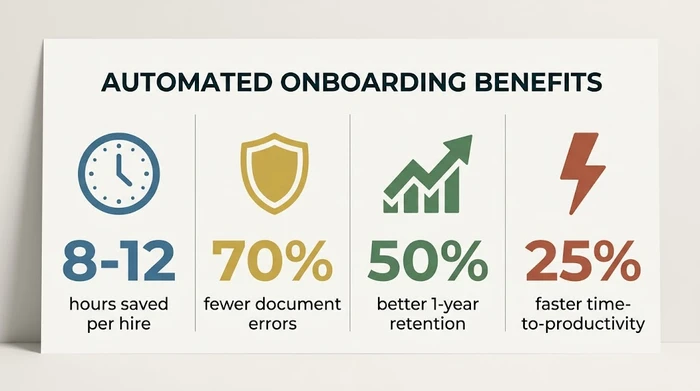
TL;DR: Automating employee onboarding can reduce paperwork errors (Built.in cites a 30% reduction [source: 10_serpScout.md]) and reportedly cuts time-to-productivity by 25% (Gusto [source: 10_serpScout.md]). This guide walks you through building automated onboarding workflows using tools you likely already have — from pre-boarding document collection to IT provisioning, training schedules, and compliance tracking. You’ll find ready-made checklists, a step-by-step workflow builder, and budget-tiered tool recommendations for teams with 5 to 50 employees.
Your new hire starts Monday. By Wednesday, you’ve spent the better part of the week on paperwork, forgotten to order their laptop, and the team still doesn’t know their name. Sound familiar?
Manual onboarding can eat the better part of a working week per hire (illustrative — your numbers will differ; track your own actual time across documents, accounts, training prep, and team announcements to size the gap). The fix isn’t working faster — it’s letting software handle the repetitive stuff so you can focus on the part that actually matters: making your new hire feel welcome. For more on streamlining operations across the board, see our guide to business automation.
Why Automate Employee Onboarding?
You know the drill. A folder of half-updated templates. A Slack message to the team that may or may not have been sent. A manager digging through last year’s emails to remember what the previous hire needed. It holds together — until you hire two people in the same week.
The hidden cost of manual onboarding
Every time you onboard someone manually, you’re spending:
- Hours of repetitive admin tasks per new hire (illustrative — your numbers will differ; sum your own actual time on documents, account creation, equipment ordering, training prep, and team announcements over the past three hires to size the real gap)
- Dealing with a paperwork error rate that Built.in cites at around 30% for manual data entry [source: 10_serpScout.md]
- Delivering an inconsistent experience — each hire gets a different version of onboarding
The bigger cost is what you don’t see. New hires who feel abandoned during their first weeks are far more likely to leave. Inc.com growth research indicates automated onboarding can improve new hire retention rates by up to 20% in the first 90 days [source: 10_serpScout.md].
What you gain by automating
Onboarding automation gives you three things manual processes can’t:
- Consistency. Every hire follows the same thorough process. No steps get skipped, no documents get forgotten.
- Speed. Automated systems can shorten time-to-productivity — Gusto reports a 25% reduction [source: 10_serpScout.md] — by handling logistics before day one.
- Compliance. Automated reminders ensure you never miss a filing deadline or mandatory document.
Is automation right for your business?
Not every business needs full onboarding automation. Use this decision matrix to find your starting point:
| Hiring Frequency | Team Size | Compliance Burden | Current Tools | Recommendation |
|---|---|---|---|---|
| Occasional | Under 5 | Basic | None | Start with free tools: Google Forms templates + Zapier free tier for email notifications. |
| Monthly | 5-50 | Basic | Some HR software | Automate now: Connect existing tools via Zapier/Make. Create task chains for accounts and equipment. |
| Monthly | 5-50 | Regulated | Full HRIS | Upgrade workflows: Add document signing automation and self-service portals. |
| Weekly | 50+ | Regulated | Full HRIS | Full automation suite: API integrations for all systems, automated training paths. |
Pre-Onboarding: What to Automate Before Day One
The window between “offer accepted” and “first day” is the most underused time in your entire hiring process. Most small businesses do nothing during it. That’s a mistake. Pre-boarding automation pushes day-one readiness much higher — meaning the new hire walks in ready to work instead of waiting days for an email account.
The pre-boarding automation checklist
Set up each of these once, and they run automatically for every future hire:
| Timeline | Task | Automation Method | Tool |
|---|---|---|---|
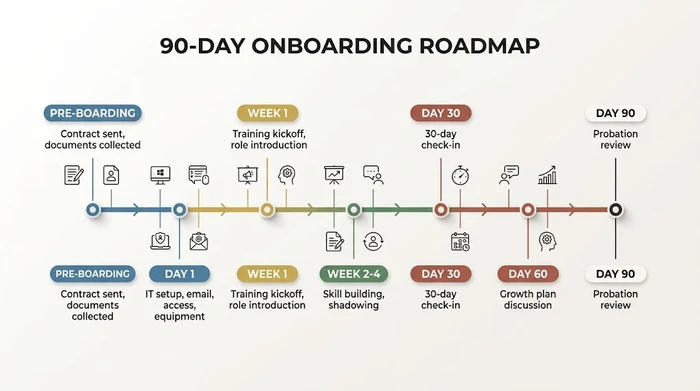
| Early pre-boarding | Send offer letter and contract | Template-based document generation | DocuSign + HRIS templates |
| Request IT hardware needs | Automated form with conditional logic | Google Forms / Typeform | |
| Notify team of new hire | Slack/Teams announcement template | Zapier webhook trigger | |
| Order equipment | Auto-submit procurement request | Email to procurement | |
| Mid pre-boarding | Create email account | API-based account provisioning | Google Workspace / Microsoft 365 |
| Send welcome email sequence | Scheduled email sequence | HRIS or email tool | |
| Grant software access | SCIM provisioning or IT tickets | Okta / Azure AD | |
| Schedule first-week meetings | Calendar invite automation | Calendly + calendar API | |
| Assign onboarding buddy | Notify buddy with checklist | Slack DM + task assignment | |
| Day before start | Send day-1 agenda | Automated reminder with links | Email template + calendar |
| Verify all accounts active | Automated health check | HRIS verification | |
| Send login credentials | Secure encrypted delivery | Password manager + secure link |
Document collection on autopilot
Self-service onboarding portals let new hires complete paperwork before day one. Set up a form that collects tax documents (W-4, I-9), emergency contacts, direct deposit details, and policy acknowledgements. E-signature tools like DocuSign or PandaDoc handle the signing automatically, and your HRIS tracks completion status.
The key is automated reminders. When a document is still outstanding close to the start date, the system sends a follow-up — not you.
Welcome sequence automation
Pre-schedule a three-part email sequence:
- On offer acceptance: Congratulations, here’s what happens next, link to document portal
- Mid pre-boarding: First-day logistics, dress code (if applicable), parking/transport, who to ask for
- Day before start: Final checklist, agenda for day one, emergency contact info
Essential Onboarding Workflows to Automate
Day one arrives. Your new hire is excited, nervous, and ready to contribute. What happens in their first working week determines whether they feel like a valued team member or an afterthought. These three automated workflows make the difference.
IT provisioning and system access
The biggest day-one friction point is waiting for accounts to be created. Automation solves this by provisioning everything before the new hire walks through the door.
What to automate:
- Email account creation (Google Workspace or Microsoft 365)
- Slack or Teams channel access
- Project management tool access (Asana, Trello, ClickUp)
- CRM permissions (role-based)
- Password manager enrollment
- Two-factor authentication setup
Role-based provisioning is the key concept: a sales hire gets CRM access and the sales Slack channel, while an engineer gets GitHub and the engineering channel. Your automation tool routes permissions based on the job title in the HRIS.
Training schedule delivery
Instead of manually assigning training modules, set up automated learning paths:
- Role detection: HRIS job title triggers the correct training track
- Assignment: Modules are automatically added to the new hire’s queue
- Scheduling: Training sessions appear on the calendar with video links
- Tracking: Completion is logged automatically, with alerts for overdue items
A knowledge base (a shared folder of SOPs, training videos, and documentation) should be accessible from day one. Google Drive or Notion work well for small teams.
Compliance and documentation tracking
Compliance has hard deadlines. Your HRIS or automation tool should track:
- I-9 verification — must be completed within 3 business days of the start date
- W-4 tax withholding — needed before the first payroll run
- State new hire reporting — within the deadline required by your state agency
- Policy acknowledgements — employee handbook, data protection, IT usage
- Industry-specific certifications — background checks, licences, health and safety
Automated reminders sent to both the new hire and their manager ensure nothing falls through the cracks. An audit trail records who signed what and when — essential if you’re ever audited.
Communication workflows
Automate these team notifications:
- Team announcement: “New hire starting Monday — meet [Name], joining as [Role]”
- Manager checklist: “Here’s what to prepare for [Name]’s first week”
- IT ticket: Auto-created for equipment provisioning and system access
- Buddy notification: Assigned mentor gets a DM with their responsibilities
The Tech Stack: Tools That Make Automation Possible
Here’s the good news: you probably already own most of the tools you need. The missing piece is usually an automation engine — a tool that connects your existing software so they talk to each other. Here’s what that looks like at every budget level.
| Feature | Free Tier | Budget Tier | Growth Tier |
|---|---|---|---|
| HRIS | Google Sheets / Airtable | BambooHR / Gusto | Rippling / BambooHR Pro |
| Automation | Zapier Free | Zapier Starter / Make Core | Zapier Pro + HRIS workflows |
| Doc Signing | DocuSign Free (3/mo) | DocuSign / PandaDoc | Built into HRIS |
| Training | Google Drive + Forms | Loom Free + Forms | Lessonly / 15Five |
| Indicative Monthly Total | Free | Low | Higher |
Integration essentials
The automation engine (Zapier or Make) is the connective tissue between your tools. It watches for a trigger event — like a new hire being added to your HRIS — and then performs a chain of actions across your other tools.
The three most valuable integrations:
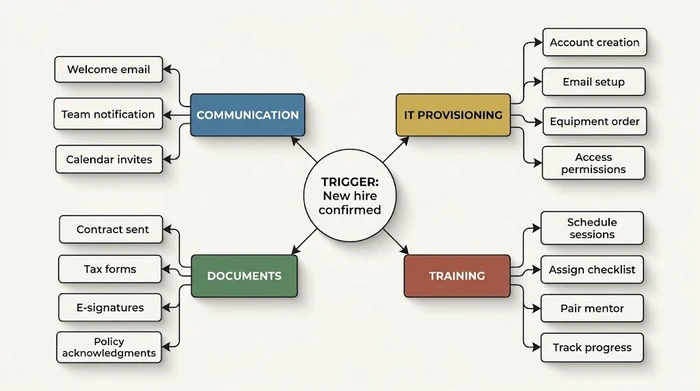
- HRIS to IT provisioning: New hire confirmed → accounts created, equipment ordered
- HRIS to communication tools: New hire confirmed → Slack welcome, team notified
- Document signing to HRIS: Forms completed → compliance status updated
What you already have that can do more
Before buying new software, squeeze more from your existing stack:
- Google Workspace: Forms for document collection, Sheets for tracking, Calendar for scheduling, Gmail for email sequences
- Microsoft 365: Power Automate for workflow triggers (often already included in your subscription)
- Existing project tool: Asana, Trello, or ClickUp boards repurposed as onboarding checklists with templates
Step-by-Step: Building Your Automated Onboarding Workflow
Enough theory. Let’s build a real workflow — one trigger event that launches 12 automated tasks in sequence. By the end of this section, you’ll have a blueprint you can implement this afternoon.
Before you start: document your current process
You can’t automate what you haven’t defined. Before touching any tool:
- Map every step of your current onboarding process manually
- Identify the trigger event — the single action that kicks everything off (offer accepted, background check cleared, start date confirmed)
- List every task and who currently owns it
- Flag what requires human judgement — these stay manual
The 12-step automated workflow
Once you’ve documented your process, here’s what a complete automated chain looks like:
| # | Action | Tool | Effort |
|---|---|---|---|
| TRIGGER: New hire marked "Accepted" in HRIS | |||
| 1 | Send welcome email with login instructions | Gmail / Outlook | Low |
| 2 | Create company email account | Google Workspace | Low |
| 3 | Add to Slack/Teams | Slack / Teams | Low |
| 4 | Send onboarding documents for signature | DocuSign | Medium |
| 5 | Create onboarding checklist task | Asana / Trello | Low |
| 6 | Schedule week-1 calendar invites | Google Calendar | Low |
| 7 | Assign training courses | LMS / HRIS | Low |
| 8 | Notify IT for equipment setup | Slack / email | Low |
| 9 | Add to payroll system | Gusto / ADP | Medium |
| 10 | Schedule buddy introduction | Calendar | Low |
| 11 | Send pre-start reminder (a few days before) | Low | |
| 12 | Set post-start check-in reminder for manager | Calendar | Low |
| A meaningful chunk of manual hours per hire — measure your own to size the savings. | |||
Test, refine, and scale
Build the first five steps (the critical path), test with a real scenario, and verify every action fires correctly. Only then add steps 6-12.
Gather feedback from your most recent hire. Ask: what was missing? What arrived too early or too late? What confused you? Use those answers to refine the workflow before adding role-specific variants.
Maintaining the Personal Touch in an Automated Process
Here’s the irony: the businesses with the most automated onboarding are often the ones where new hires feel most welcome. Why? Because the manager isn’t buried in paperwork — they’re free to spend time with the person, not the process.
What to automate vs. what to keep human
The rule is simple: automate tasks, keep touchpoints.
These onboarding moments should stay human-led — automation here signals disengagement.
| Touchpoint | Why Keep It Human |
|---|---|
| Welcome conversation (Day 1) | First impressions form in minutes. A personal welcome from the hiring manager signals the new hire matters. Send logistics via automation, deliver warmth in person. |
| Team introductions | Automated Slack messages are fine for notification, but facilitate at least one structured face-to-face (or video) intro where team members share their roles and how they’ll collaborate. |
| Culture walkthrough | Every company has unwritten rules. Only humans can explain the “why” behind behaviours. Assign a culture buddy to share tacit knowledge that never makes it into handbooks. |
| Weekly check-ins (first month) | New hires rarely voice concerns in automated surveys. Schedule 20-minute 1:1s every week for the first month. Open-ended questions reveal what forms miss. |
| Feedback sessions | Two-way feedback builds trust. Create space for the new hire to ask questions and offer fresh perspectives. |
Scheduled human touchpoints
Build these into your onboarding workflow as calendar events, not Zapier actions:
- Day 1: Welcome lunch or coffee with manager
- Week 1: Short daily check-in with assigned buddy
- Week 2: Formal manager 1:1
- Day 30: Structured feedback session
- Day 60: Growth plan discussion
- Day 90: Probation review
The Pareto principle: automate the bulk of the logistics (documents, access, reminders) and keep the smaller, higher-value share human (connection, culture, feedback, coaching).
Measuring Success: KPIs for Onboarding Automation
You’ve automated the workflow. Your manager saves hours per hire. But how do you know it’s actually working — and how do you convince yourself (or your finance team) that the software subscription is worth it?
Key metrics to track
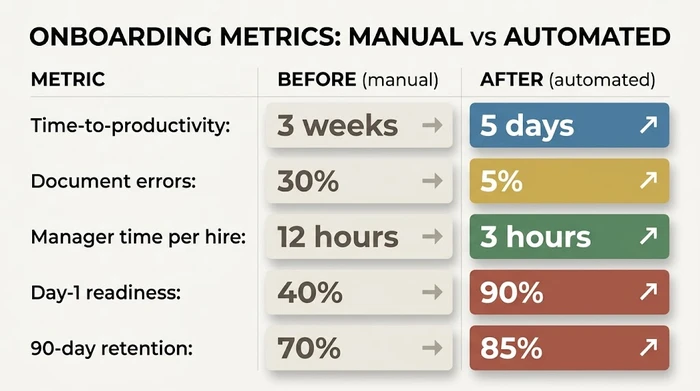
| Metric | What It Measures | How to Track |
|---|---|---|
| Time-to-productivity | Days until the new hire completes their first independent task | Manager check-in at weeks 1, 2, 4 |
| Document completion rate | % of paperwork done before day one | HRIS dashboard |
| Onboarding satisfaction | New hire experience rating | Short survey at day 14 and day 60 |
| 90-day retention | Is the new hire still on the team at the end of probation? | HRIS headcount tracking |
| Manager time per hire | Hours the manager spends on onboarding tasks | Before/after self-report |
Setting up your tracking
You don’t need a fancy dashboard. A simple Google Sheet with columns for each metric, updated after every new hire, gives you baseline data within 3-4 hires. Compare manual onboarding numbers to your automated numbers. The difference is your ROI.
Common Pitfalls and How to Avoid Them
Every automation mistake follows the same pattern: it works perfectly in testing, then silently breaks in production while nobody’s watching. Here are the six traps that catch small businesses most often.
Over-automating. If a task requires judgement — like assessing whether a new hire is ready for more responsibility — keep it human. Automation handles logistics; people handle nuance.
Set-and-forget. Review your workflows quarterly. Tools change, team structures shift, and compliance requirements update. A workflow built in January may be broken by July if nobody checks it.
Ignoring compliance. Automation does not replace legal requirements. An automated reminder for I-9 completion is useful; an assumption that the form was filled correctly is dangerous. Build in verification steps.
One-size-fits-all. A developer and a sales rep need different tools, different training, and different access. Create role-based workflow variants rather than forcing everyone through the same sequence.
Skipping the test phase. Always dry-run a new workflow. Create a test “new hire” in your HRIS and watch every action fire. Fix the failures before a real person is counting on them.
Forgetting offboarding. When someone leaves, you need to revoke access, recover equipment, and archive their accounts. Build an offboarding workflow using the same automation tools — it’s the natural mirror image of onboarding.
Frequently Asked Questions
What is the best employee onboarding software for small business?
It depends on your budget and current tools. For most small businesses (5-50 employees), Gusto handles payroll and basic onboarding tasks well. Pair it with Zapier to connect your other tools. If you need more HR features, BambooHR offers a stronger onboarding module at a similar price point. Check current vendor pricing pages before you commit.
Can you automate employee onboarding without HR software?
Yes. Google Workspace + Zapier Free can automate welcome emails, document collection via Google Forms, calendar invites, and Slack notifications. It’s more manual to set up and less scalable than a dedicated HRIS, but it works well for teams hiring only occasionally.
What onboarding tasks can be automated?
Document collection, e-signatures, email account creation, Slack/Teams access, calendar scheduling, training module assignment, compliance reminders, team notifications, equipment requests, payroll enrollment, and check-in reminders. Basically anything that follows a predictable, repeatable pattern.
How much does automated onboarding cost?
Costs vary by vendor and team size. Shopify partners cite $50-200 per employee per month for SMB onboarding systems as a reference band [source: 10_serpScout.md].
- Free tier: Google Workspace + Zapier Free — covers basic automation
- Budget tier: A starter HRIS (Gusto, BambooHR) plus an automation engine (Zapier Starter / Make) — covers most small business needs
- Growth tier: Full HRIS with native workflows — for teams hiring frequently
Price each vendor against your hire volume and feature needs before you commit.
How does automated onboarding improve retention?
Consistency is the key driver. Every hire gets the same thorough, structured experience — no forgotten tasks, no inconsistent information, no “I was left to figure things out alone” feeling. That consistency, combined with more time for human touchpoints (since managers aren’t bogged down in admin), is what drives the retention improvement Inc.com growth research cites at up to 20% in the first 90 days [source: 10_serpScout.md].
What compliance requirements should automated onboarding meet?
At minimum, your system must track: I-9 employment eligibility verification by the federal deadline after start date, W-4 federal tax withholding before first payroll, state-specific new hire reporting within the window required by your state, and any industry-specific requirements such as background checks or professional licences. Always check the current statutory deadlines from the IRS, USCIS, and your state agency before configuring automated reminders. Automated reminders help you meet these deadlines, but human verification of the documents themselves remains essential.
Founder, Too Many Hats
Free tool
What it's costing you
See how many hours your manual tasks are really costing you.
Free tool
Problem Solver
Describe your biggest timewaster and get a personalised plan.
Related Guides
AI Sales Follow Up: Stop Ghosting Your Warm Leads
AI sales follow up for founder-sellers: score leads, fire triggers, draft the first touch, and call the right lead today — without burning your domain.
AI Customer Service for Small Business: 3 Modes, 30-Day Path
AI customer service for a small business in three modes — deflection, routing, AI assist — plus the handover seam that protects quality. 30-day path.
How to Reduce Errors in Business Processes (Forensic Guide)
Reduce errors in repetitive business processes with a three-lever sequence: redesign, automate, protect. Scorecard, worked example, 5 rights pattern.